Finishing a manuscript is a major achievement, but completing the first draft does not necessarily mean a book is ready for readers. Even experienced authors can overlook inconsistencies, weak transitions, unnecessary scenes, repetitive ideas, grammatical mistakes, or sections that need stronger development. This is where professional manuscript editing services can make a significant difference.
Whether you are writing your first novel, developing a memoir, creating a business book, or turning your expertise into nonfiction, editing helps transform a rough manuscript into a polished and readable book. Understanding what manuscript editing involves and when you need it can help you choose the right approach for your project.
What Are Manuscript Editing Services?
Manuscript editing is about making a book after it’s written or nearly written. It means looking at the story and all its parts. This includes how the plot flows, how characters grow and whether the ideas connect well. It also covers details like sentence clarity, grammar, punctuation and keeping things consistent throughout the book.
Professional editing goes beyond fixing typos and grammar errors. A skilled editor checks how the book works as a whole. They look for sections that might confuse readers stories that drag repeated ideas or points that don’t land as the author intended. Their goal is to help the book reach its potential.
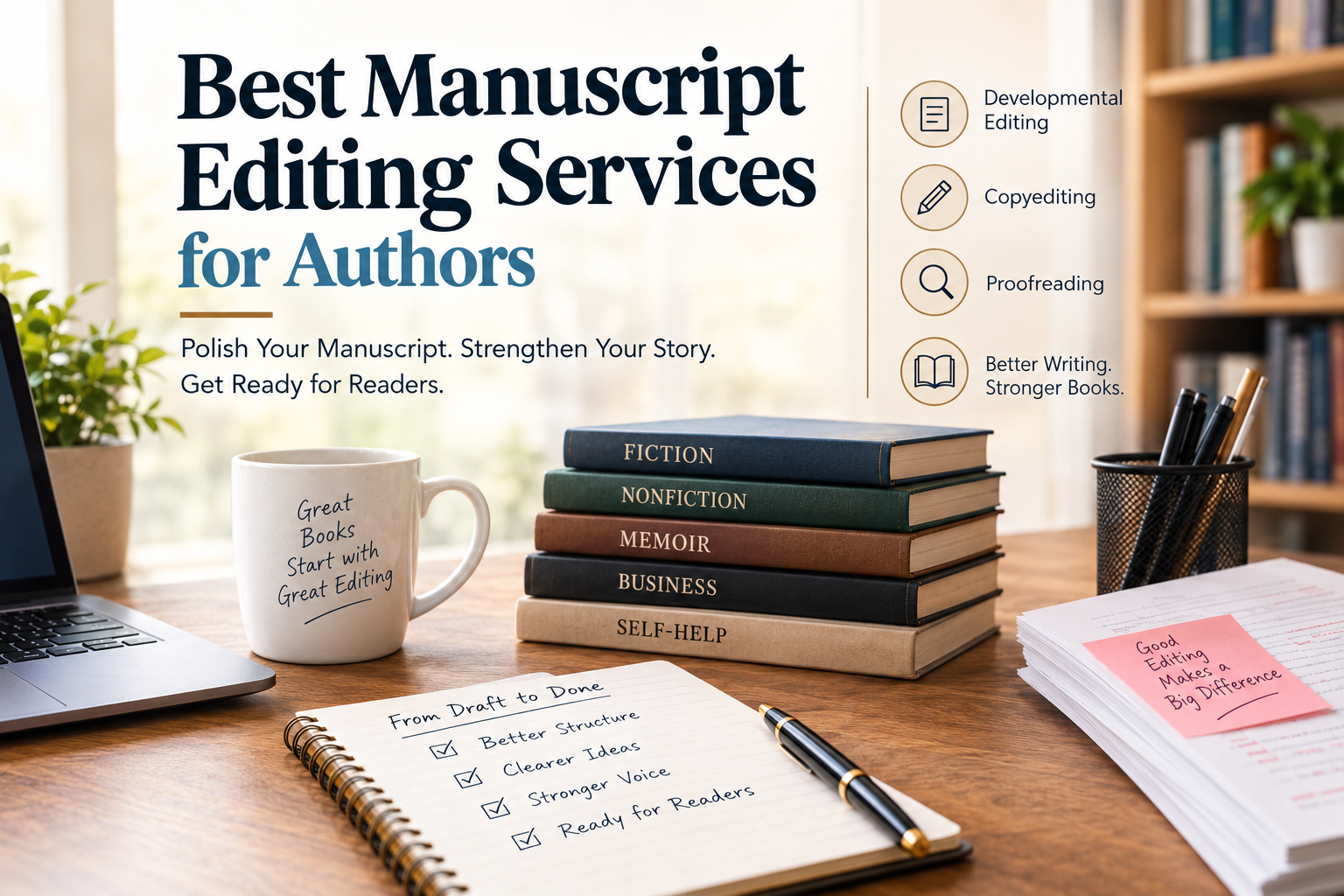
The kind of editing needed depends on where the manuscript stands and what the author wants to achieve. If a novel has issues, with its structure it might need developmental editing. If the story is mostly ready and just needs polishing, copyediting and proofreading may be enough. Each step plays a role in shaping the final book.
What Is the Difference Between Developmental Editing, Copyediting, and Proofreading?
Understanding the stages of editing is important because each one solves a different problem. Developmental editing focuses on the picture. For fiction developmental editing can include plot, pacing, character development, conflict, structure and narrative consistency. For nonfiction developmental editing may involve organization, arguments, chapter structure, explanations and the overall reader experience.
Copyediting happens at a detailed level. Copyediting focuses on sentence construction, grammar, punctuation, word usage, consistency, readability and style. Copyediting helps ensure that the manuscript communicates the authors ideas clearly and professionally.
Proofreading is usually the quality‑control stage. Proofreading catches remaining errors formatting problems, punctuation mistakes, missing words and other small issues that may remain after editing. A strong publishing process may require all three stages than treating editing, as a single task.
When Should You Edit a Manuscript?
Many first‑time authors think about whether they should edit while they write or wait until the first draft is finished. In situations it helps to finish a usable draft before doing a lot of editing.
Continuously rewriting chapters while you try to finish the manuscript can slow your progress and make it hard to see the book as a whole. When the draft is finished you can look at its structure spot spots and make better choices, about what must change.
That does not mean you should ignore mistakes while you draft.. Major editing is usually more useful when you have enough of the manuscript done to see how all of its parts fit together.
How Do You Edit a Book Manuscript?
The editing process usually begins with an assessment of the manuscript. The editor examines the writing, structure, genre, intended audience, and current level of development before determining what kind of editing is needed.
For a novel, the editor may evaluate whether the opening captures attention, whether characters develop naturally, whether scenes move the story forward, and whether the pacing remains engaging. For a nonfiction or business book, the focus may be on whether the ideas are organized logically, whether explanations are clear, and whether each chapter contributes to the book’s central purpose.
After the larger issues are addressed, the manuscript can move into sentence-level editing and proofreading. This staged approach helps prevent polishing sentences that may later be removed or completely rewritten.
How Long Does Manuscript Editing Take?
There is no one schedule that fits all books when it comes to editing. The size of the manuscript how good the first version is, how hard the topic is, what kind of editing is needed and how times it needs to be changed can all influence how long it takes.
A small manuscript that is already pretty good might take less time compared to a long novel, a personal story or a nonfiction book that has a lot of research. Developmental editing can also take time because it might mean changing the structure and writing parts over again.
Writers should be careful, about picking an editing service just because it says it can finish quickly. Good editing needs time to really get to know the manuscript instead of just using a computer program to check it.
How Many Words Should a Book Have Before Editing?
A manuscript does not need to reach a specific word count before it can be edited. The appropriate length depends on the genre, audience, purpose, and scope of the book.
A business book may be relatively concise, while a novel may need considerably more words to develop its characters and story. A memoir should contain enough detail to create a meaningful narrative without including every event from the author’s life.
Instead of adding unnecessary content to reach an arbitrary word count, authors should focus on whether the manuscript feels complete and delivers what readers expect from its genre.
Can AI Edit a Manuscript?
AI writing tools can help catch grammar mistakes make sentences clearer offer ways to say things and point out when the same words are used too often.. These tools shouldn’t be seen as a full substitute for a professional editor’s judgment.
An AI might flag a sentence as awkward. It won’t know why that sentence matters to the story. It might suggest changing an author’s style just because the words sound strange. In fiction the tool could miss how a character decision ties, into a bigger theme. In a memoir it can’t feel the weight behind a personal moment.
So AI can be an assistant but writers should still rely on human editors when the manuscript needs help with big-picture structure keeping things consistent protecting the author’s voice and truly understanding what the reader should feel.
How Do You Choose the Best Manuscript Editing Service?
The best editing service is not necessarily the one with the lowest price or the fastest turnaround. Authors should consider whether the editor understands their genre, communicates clearly, provides meaningful feedback, and understands the difference between correcting a manuscript and improving it.
It is also important to understand exactly what the service includes. Some editors focus primarily on grammar and punctuation, while others provide developmental feedback, rewriting assistance, formatting, or multiple rounds of revisions.
Before choosing an editor, authors should also consider whether they need editing alone or broader professional writing support. Someone with a finished manuscript may only need editorial assistance, while an author with a book idea, rough notes, or an incomplete draft may need help much earlier in the process.
Should You Hire a Professional Manuscript Editor?
Hiring an editor is especially useful when you have spent many months or years working on a manuscript and you are too close to the manuscript to see its weaknesses. A fresh editorial perspective can reveal problems that’re hard for an author to see on their own.
Professional editing can also help first‑time authors who do not know publishing standards. Of guessing whether a chapter works whether the structure is strong or whether the writing is ready, for readers authors can get informed feedback that matches the manuscript’s goals and audience
For authors who have not yet finished a manuscript, professional book writing or ghostwriting may be a first step. A ghostwriter can help develop the idea arrange the material conduct interviews or research when needed and turn an author’s knowledge or experiences into a structured manuscript. Editing can then be added later in the book preparation.
How Does Professional Book Editing Work?
Professional manuscript editing usually begins with understanding the author’s vision. The editor needs to know what the book is trying to accomplish, who it is written for, and what kind of reading experience the author wants to create.
The manuscript is then reviewed according to the level of editing required. Major structural concerns may be addressed before sentence-level corrections, allowing the final version to develop logically rather than simply becoming a grammatically polished draft.
Authors should remain involved throughout the process. Good editing does not erase the author’s personality or replace their ideas. Instead, it strengthens the manuscript while preserving the voice and purpose that make the book unique.
Final Thoughts
The manuscript editing services do more than fix grammar mistakes. They help authors see how their manuscript functions, where it can be better and what changes can make the final book easier to read more powerful and more interesting.
If you are still working on your book start by focusing on building your idea and finishing a draft that works. Once the first version is done decide if it needs a picture edit, a line, by line edit, a final check or some of these services together.
If you have a book idea but are having trouble making it into a full manuscript you don’t have to do it all by yourself. Professional book writers and people who write books for others can help shape the idea and organize the manuscript while professional editors can make the final version better. The goal is not just to write words. It is to make a book that shares its ideas well and makes readers want to keep reading.
Frequently Asked Questions
What is the best type of editing for a first-time author?
It depends on the condition of the manuscript. A first-time author with structural problems may benefit from developmental editing, while a polished manuscript may primarily need copyediting and proofreading.
How much does manuscript editing cost?
The cost varies according to manuscript length, editing level, genre, complexity, and the amount of work required. A professional assessment can help determine which services are actually necessary.
Can an editor rewrite my entire book?
An editor can recommend and sometimes perform substantial revisions, depending on the service agreement. If a manuscript requires extensive writing rather than editing, a ghostwriter or professional book writer may be more appropriate.
Is manuscript editing necessary before publishing?
While there is no universal publishing requirement that every manuscript must receive the same type of editing, professional editing can significantly improve clarity, consistency, readability, and overall quality before publication.