Ghostwriter vs. Self-Writing: Which Is Right for You?
You have a book idea, but turning that idea into a complete manuscript can feel overwhelming. Whether you are a first-time author, aspiring fiction writer, entrepreneur, coach, expert, or someone with a story to tell, one of the biggest decisions you will face is whether to write the book yourself or hire a professional ghostwriter. Self-writing gives you complete control over every word, while ghostwriting allows you to work with a professional writer who can transform your ideas, knowledge, experiences, or story into a structured manuscript. Neither option is automatically better; the right choice depends on your goals, available time, writing experience, budget, and how involved you want to be throughout the process.
What Is Self-Writing?
Self-writing means taking responsibility for developing and writing your manuscript. Self-writing creates the concept researches the subject organizes the chapters writes the content revises the manuscript and prepares it for editing and publishing. For authors this process is personally rewarding because every sentence comes directly from them. Fiction writers may enjoy creating characters, scenes, dialogue and plotlines while nonfiction authors may appreciate explaining their knowledge and experiences. Self-writing also provides creative control and eliminates the direct cost of hiring a writer. However writing a book requires more, than putting words on a page. Self-writing must keep the story steady. Self-writing needs to maintain structure, consistency, pacing, clarity and motivation over thousands of words. Many first-time authors struggle with knowing how to begin creating an outline maintaining momentum avoiding repetition revising chapters too frequently or finishing the manuscript once the initial excitement disappears.
What Is Ghostwriting?
Ghostwriting is a professional writing arrangement in which a writer creates content based on another person’s ideas, knowledge, experiences, research, direction, or story. In book publishing, a ghostwriter can help transform a rough concept, collection of notes, interviews, personal experiences, or existing material into a complete manuscript. Ghostwriters work with entrepreneurs, business owners, coaches, consultants, experts, public speakers, fiction writers, nonfiction authors, and first-time authors. Their role goes beyond simply writing sentences. Depending on the project, a professional ghostwriter may help with research, organization, chapter development, narrative flow, tone, readability, storytelling, and revisions. The author remains closely involved by providing ideas, feedback, source material, and creative direction, while the ghostwriter handles much of the writing and development work.
Ghostwriter vs. Self-Writing: What Is the Difference?
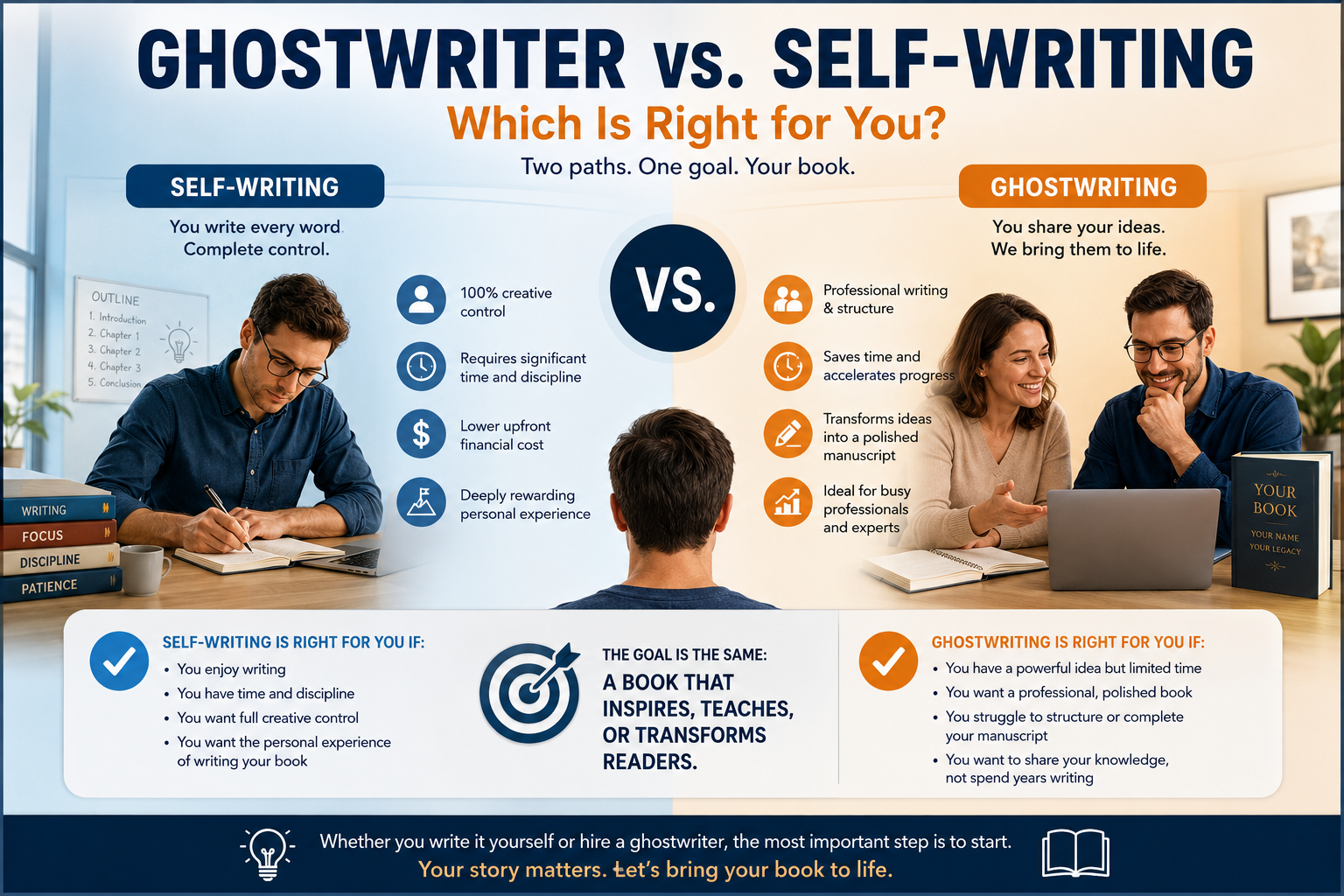
The main difference is who handles the writing process. When you self-write you create the manuscript yourself. Take full responsibility for every word. Ghostwriting on the hand moves most of the writing work to a professional. Self-writing usually demands a large amount of your time but it gives you complete creative control and a deep personal connection to the book. Ghostwriting requires a money investment. It cuts down the time you must spend writing and offers expert help with structure and style. Self-writing is ideal for authors who love writing have plenty of time know their genre well and want to feel the joy of finishing their own manuscript. Ghostwriting works best for people who have an idea but little time limited writing experience or low confidence, in arranging and completing a book.
How Do You Start Writing a Book?
If you choose to write your book on your own start with the picture and not right away with Chapter One. First think about why you’re writing the book, who you want to reach what you want people to learn or feel and what makes your idea special or different. Then figure out who your target reader is because your audience affects your tone the words you use the examples you give the way you organize the book and how detailed you get. After you have the purpose and the audience clear make an outline that works like a map for the book. A nonfiction book might go from a problem to its background, solutions ways to handle it examples and how to put it into action while a fiction book might start with setting and conflict then build up have big moments reach a peak and end with a conclusion. Once the structure is clear set up a writing schedule that you can actually stick to. You could try writing 500 words a day 1,000 words a day or have a focused writing times each week. The important thing is not to make the first draft perfect. The first draft is about putting ideas down on paper; grammar, speed, how ideas flow, repetition, characters and the way the book is put together can be fixed later when you go back, to revise.
How Long Does It Take to Write a Book?
There is no universal timeline because the time required depends on the genre, word count, research, writing speed, complexity, and revision requirements. A short nonfiction book can take considerably less time than a complex novel, while an author writing every day will usually progress faster than someone who writes only on weekends. For example, if your manuscript goal is 60,000 words and you consistently write 500 words per day, you would need approximately 120 writing days to produce the first draft. That is around four months of writing every day, without accounting for outlining, research, editing, revisions, interruptions, or days when you cannot write. This is why the complete book-production process usually takes longer than simply calculating the number of days required to create a first draft.
How Many Words Should a Book Have?
There is no single word count that every book must meet. The appropriate length depends on genre, audience, subject, publishing format, and reader expectations. As a general planning guideline, short nonfiction books may contain approximately 20,000 to 40,000 words, standard nonfiction often falls around 40,000 to 70,000 words, business and professional books frequently fall within approximately 35,000 to 70,000 words, contemporary romance may range from approximately 60,000 to 90,000 words, and general adult fiction often falls around 70,000 to 100,000 words. These are not rigid requirements. A book should be long enough to deliver its intended experience, information, or transformation without unnecessary filler. A focused 35,000-word book can be more valuable than an 80,000-word manuscript filled with repetition.
How Do You Organize a Book?
Good organization makes a book easier to write and easier for readers to follow. Nonfiction books often work well when they move from a problem to context, explanation, solution, application, and results. For example, a productivity book might begin by identifying common productivity problems, explain why those problems occur, introduce a practical framework, provide strategies, and finish with an implementation plan. Fiction requires a different structure because readers expect a compelling protagonist, meaningful goal, conflict, obstacles, stakes, character development, turning points, climax, and resolution. Every chapter should contribute something meaningful to the overall story. If removing a chapter does not change the story or reader experience, that chapter may need to be reconsidered.
When Should You Hire a Ghostwriter?
Hiring a ghostwriter can be a practical option when you have a valuable book idea but lack the time, writing experience, or confidence to turn that idea into a finished manuscript. Entrepreneurs, executives, coaches, consultants, and professionals often have enough knowledge for an entire book but cannot dedicate hundreds of hours to writing because of their business and career responsibilities. A ghostwriter can turn interviews, notes, conversations, research, and existing material into organized chapters while allowing the author to remain involved in the important decisions. Professional writing assistance can also be useful if you repeatedly start manuscripts but never finish them, struggle to organize your ideas, or know what you want to say but cannot communicate it effectively in long-form writing.
When Should You Write the Book Yourself?
Self-writing may be the better option if you enjoy writing, have enough time, want complete control over every sentence, are comfortable researching and outlining, and are prepared to revise the manuscript multiple times. You do not have to be a professional writer to write a successful book, but you should understand that completing a book requires consistency and patience. If the experience of personally writing every chapter is an important part of your goal, self-writing can be especially rewarding.
Can You Combine Self-Writing and Ghostwriting?
You do not necessarily have to choose between doing everything yourself and handing the entire project to someone else. A hybrid approach can combine both methods. You might develop the core idea yourself, provide notes and personal experiences, work with a professional to create the structure, write certain chapters independently, have a ghostwriter develop other sections, and then use professional editing to polish the completed manuscript. This can be especially useful when you want to remain deeply involved in the project but need help with organization, consistency, structure, or specific sections.
How Does Professional Book Writing Work?
Professional book writing generally begins with a discovery and consultation stage in which the writer learns about your book concept, target audience, goals, preferred tone, subject matter, experiences, research, existing materials, desired length, and publishing plans. The writer may then conduct research, review documents, interview the author, and develop a detailed outline. Once the structure is approved, the manuscript is written according to the agreed direction. The author reviews the content and provides feedback, after which the writer revises the manuscript to improve structure, tone, pacing, clarity, consistency, and completeness. Once the manuscript is finalized, it can move into professional editing, proofreading, formatting, cover design, and publishing depending on the author’s requirements. A strong professional writing process should remain collaborative, with clear communication between the author and writer throughout the project.
How Much Does a Ghostwriter Cost?
Ghostwriting costs vary depending on word count, genre, research requirements, complexity, writer experience, interviews, revisions, project timeline, and the services included. A short nonfiction project is very different from a heavily researched business book or full-length novel, so there is no single price that applies to every project. When comparing professional writing services, do not focus only on the lowest quote. Consider what is included, how many revisions are provided, whether research and outlining are included, how the writer handles confidentiality, what the expected timeline is, and what happens if the project changes direction. A clear agreement helps establish expectations for both the author and the writer.
What Makes a Good Ghostwriter?
A good ghostwriter needs more than strong grammar and vocabulary. They should be able to understand your voice, ask thoughtful questions, organize complex information, adapt their writing to your genre and audience, communicate clearly, accept feedback, and maintain consistency throughout a long manuscript. For nonfiction projects, the writer should be able to transform specialized knowledge into information that ordinary readers can understand. For fiction, the writer should understand elements such as characterization, dialogue, pacing, conflict, narrative structure, and genre expectations. Most importantly, the writer should understand that the book represents the author’s ideas, identity, expertise, or story.
Ghostwriter vs. AI vs. Self-Writing
Artificial intelligence has created another option for modern authors. AI tools can assist with brainstorming, outlining, research organization, idea development, and early drafting, but technology does not eliminate the need for human judgment. A book still needs a clear purpose, original ideas, accurate information, consistent voice, strong structure, effective storytelling, and careful revision. AI can be useful as a writing assistant, while a professional ghostwriter provides a human-led service focused on understanding the author’s goals, perspective, experiences, and audience. For an author creating a commercially important book, the important question is not simply whether technology can generate words, but whether the finished manuscript communicates the right ideas to the right readers in a compelling, accurate, and trustworthy way.
7 Questions to Ask Before Choosing Self-Writing or Ghostwriting
Before deciding which approach is right for you, ask yourself whether you realistically have enough time to write a complete manuscript, whether you actually enjoy long-form writing, whether you understand how to structure a book, how quickly you want the manuscript completed, whether personally writing every word is important to you, how important the book is to your business or professional reputation, and whether your budget is better spent on professional assistance. Self-writing primarily requires an investment of time, while ghostwriting requires a financial investment. Both have a cost, so your decision should consider which resource is more valuable in your situation.
A Simple Decision Guide
Pick self-writing if you have the time and you truly love to write. You should pick self-writing if you know your subject well. You want to have total control over every single part of your manuscript. You might want to look into ghostwriting if you have an idea but you do not have much time to spare. Ghostwriting is a fit if you lack writing experience or if you do not feel confident, about how to structure and finish your book. You can try an approach if you want to stay very involved but you still need a professional to help you with outlining, certain chapters, manuscript development or editing. My advice is that there is no best way to do this. The real goal is to pick the method that helps you actually finish the book you want to write.
Your Book Idea Does Not Have to Stay an Idea
Many books begin with something simple: a business lesson, personal experience, area of expertise, fictional character, relationship story, problem that needs solving, or idea that continues to occupy your thoughts. The real challenge is transforming that idea into a complete manuscript. If you have the time and motivation, self-writing can be an incredibly rewarding experience. Start by defining your purpose, understanding your reader, creating an outline, establishing a realistic schedule, and focusing on completing the first draft before trying to perfect every sentence. If you have the expertise and ideas but lack the time or writing experience needed to develop them into a professional manuscript, working with a professional ghostwriter or book writing service can help bridge the gap between your idea and a finished book. Your first decision does not have to be whether you are a writer or a non-writer. You are the person with the story, knowledge, or idea. The real question is whether you want to write every word yourself or collaborate with a professional who can help transform your vision into a complete manuscript.
Frequently Asked Questions
Is it better to write a book yourself or hire a ghostwriter?
It depends on your goals, time, writing ability, and budget. Self-writing provides maximum control and personal involvement, while ghostwriting can save time and provide professional writing and structural expertise.
How do I start writing a book for the first time?
Start by defining your book’s purpose, target reader, central idea, and structure. Create an outline before writing the complete manuscript, then establish a realistic writing schedule.
How long does it take to write a book?
The timeline varies according to genre, word count, research requirements, writing speed, and revision. A first-time author may need several months or longer to complete a manuscript.
How many words should my book be?
There is no universal requirement. Many nonfiction books fall somewhere around 40,000 to 70,000 words, while adult fiction is often longer. Your genre and intended audience should influence your target length.
Can a ghostwriter write a book from my idea?
Yes. A professional ghostwriter can develop a manuscript from an idea, outline, interviews, notes, research, personal experiences, or existing material depending on the project’s requirements.
Will a ghostwriter write in my voice?
A skilled ghostwriter should work to understand and reproduce the author’s intended voice, tone, perspective, and communication style. This usually requires interviews, source material, discussions, and author feedback.
Do I have to give up my ideas if I hire a ghostwriter?
No. Ghostwriting is generally collaborative. The author provides the ideas, expertise, experiences, or creative direction, while the ghostwriter helps transform those elements into written content according to the agreed project scope.
Should first-time authors hire ghostwriters?
First-time authors can benefit from ghostwriting when they have a strong concept but lack the time, writing experience, or structural knowledge needed to complete the manuscript independently.
Can a ghostwriter help organize my book before writing?
Yes. A professional writer can help develop a book structure and outline before the full manuscript is written. This can establish the chapter sequence, major ideas, narrative direction, and overall flow.
Final Takeaway
Self-writing is ideal when you want to write the book yourself and have the time and skills to manage the process. Ghostwriting is ideal when you have the vision but need professional help turning that vision into a finished manuscript. There is no universally correct choice. The best approach depends on your resources, timeline, experience, budget, and purpose for writing the book. If your book idea is ready but the blank page keeps getting in the way, professional book writing assistance can help bridge the gap between having a book idea and holding a completed manuscript.